
Distribution & FMCG
Distribution Fleet Management for Vans and Light Trucks Across Every Branch
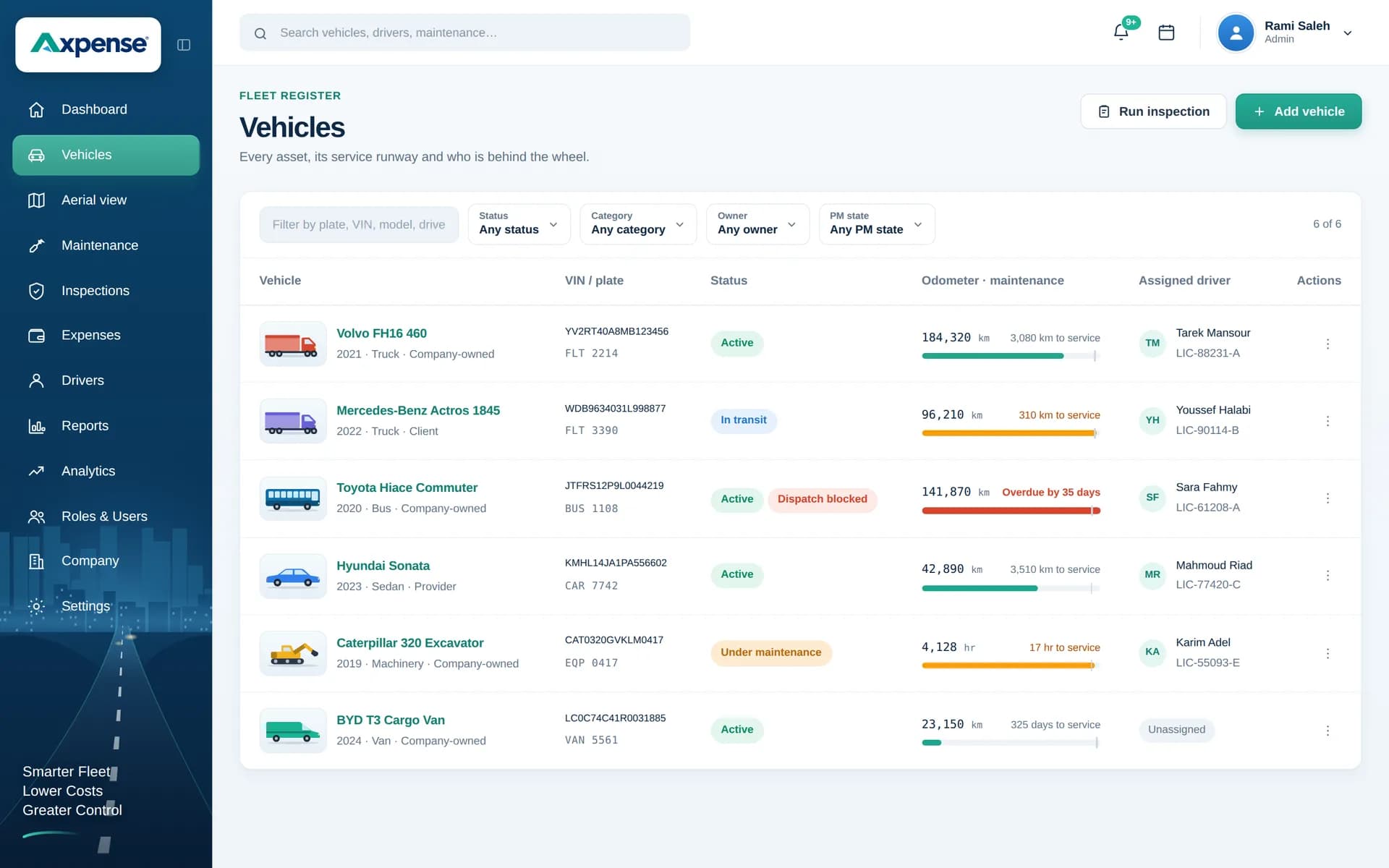
A distribution fleet is dozens of light vehicles doing short, busy routes from several branches, with drivers who change more often than the vans do. Axpense gives head office one view of every vehicle, who drives it, what service is due and what each branch spends to keep its routes running.
What makes a distribution fleet hard to manage
FMCG and wholesale distributors don’t usually run the biggest vehicles, but they run a lot of them, in many places at once. The difficulty is scale and spread rather than any single truck.
- Branches work differently. Each branch keeps its own sheet, uses its own workshop and reports in its own format, so head office compares numbers that don’t match.
- Drivers change routes and vans. Salesmen-drivers move between routes, cover leave and swap vehicles, and nobody is sure who had a van when a dent or fault appeared.
- Stop-start wear is invisible. A van making 40 drops a day wears brakes and tyres much faster than its kilometres alone suggest.
- Small costs add up. A tyre here and a brake job there never look serious until someone totals them per vehicle.
Vehicles in a typical distribution fleet
Most distributors run panel vans and refrigerated vans for route sales and deliveries to shops, light trucks for bulk drops to wholesalers and supermarkets, pickups for smaller branches and rural routes, and cars for supervisors and merchandisers.
In Axpense every vehicle has one record with its plate, make, model, odometer, status and assigned driver. The whole fleet sits in one system, so head office sees all branches together while each branch still works on its own vehicles.
Maintenance needs: brakes, tyres and km-based services
Distribution routes are hard on consumables. Frequent stops, short trips and heavy loads mean brake pads, tyres, clutches and suspension parts need attention sooner than on a highway vehicle with the same kilometres.
Axpense schedules preventive maintenance by kilometre, so each van shows the distance left to its next service and the overdue ones stand out. For the parts that wear fastest, the spare parts module records which tyres and pads went into which van, so if one vehicle keeps needing brakes, you can see it and ask whether it is the route, the driver or the part.
As an example only, many light vans run oil services somewhere between 5,000 and 10,000 km; always follow the manufacturer’s schedule for your vehicles and conditions. More on building the schedule in our fleet maintenance software overview.
Cost needs: cost per van and per branch
Distribution managers need two views of cost: per vehicle, to spot the vans that cost too much, and per branch, to compare how each location runs its fleet. Axpense records repairs, parts, insurance, registration and other expenses against the vehicle and category, and reports roll them up so you can compare.
An example of what that comparison can reveal:
| Branch (example) | Vans | Repairs & parts last quarter | Per van |
|---|---|---|---|
| Branch A | 25 | 75,000 SAR | 3,000 SAR |
| Branch B | 20 | 92,000 SAR | 4,600 SAR |
A gap like this is a prompt to look closer: older vans, harder routes, a different workshop or missed services. See fleet cost tracking for the full cost picture.
Inspection needs: quick daily checks at the branch
Route vans leave early and come back late, so checks need to be short. A typical daily list covers:
Tyre condition and pressure, including the spare.
Brakes, lights, indicators and horn.
Mirrors, doors, shutters and cargo area locks.
Refrigeration unit running and at temperature, for chilled vans.
Visible damage, noted with the driver who has the van.
A distribution workflow in Axpense
- 1
Add every vehicle from every branch
One record per van, truck and car, with odometer and status.
- 2
Assign drivers to vans
When a driver changes route or covers leave, update the assignment so responsibility follows the vehicle.
- 3
Set km service intervals
Axpense tracks km left to each service and flags overdue vehicles.
- 4
Run daily checklists
Pass or fail per item; failed items are recorded on the van for the branch to fix.
- 5
Log costs as they happen
Tyres, brake jobs, repairs and insurance recorded per vehicle and category.
- 6
Compare branches monthly
Use reports to compare cost and maintenance status across locations.
Modules distributors rely on
Vehicle management
Every van and truck across all branches in one searchable list.
Driver management
Clear driver-to-vehicle assignment, even with frequent route changes.
Preventive maintenance
Km-based service reminders and a visible overdue list.
Spare parts
Tyres and brake parts traced to the van they were fitted to.
Inspections
Short daily checklists with failed items kept on record.
Reports
Cost by vehicle and category, rolled up for branch comparison.
KPIs distribution managers track
Standard practice for route-based fleets; you can build each one from the records kept in Axpense.
Repair and parts cost per van, and per branch.
Tyre and brake spend per 10,000 km, to spot hard routes or hard drivers.
Services overdue per branch.
Vans off the road on a given morning, against vans needed for the routes.
Open failed inspection items older than a week.
Example: a distributor with 60 vans across three branches
Consider a hypothetical food distributor with 60 vans split across three branches. Each branch manager keeps a spreadsheet; drivers swap vans when someone is on leave; head office sees costs only as a monthly total from finance.
The fleet coordinator registers all 60 vans in Axpense with odometers and current drivers, and sets service intervals by kilometre. Branch supervisors start short daily checklists. Within the first weeks, a handful of vans show as overdue and are booked in, and a failed brake item recorded on one van reaches the workshop the same day instead of waiting for the driver’s next visit to the office.
After a few months of recording tyres, brake jobs and repairs per van, the coordinator can compare branches like for like and see which routes wear vehicles fastest. Keeping driver assignments up to date links each van to a named driver, which makes the conversation with branch managers factual rather than personal.
Frequently asked questions
Can we manage vans from several branches in one account?
Yes. All vehicles sit in one system, so head office sees every branch together, and reports let you compare cost and maintenance status across locations.
How does Axpense handle drivers who switch vans?
You update the driver assignment on the vehicle whenever a driver changes van, so the current driver is always clear and inspections and expenses can be linked to the right person.
Why do our vans need brakes more often than the kilometres suggest?
Stop-start routes with many drops wear brakes, tyres and clutches faster than steady driving. Tracking those parts per van, as Axpense does, shows which vehicles and routes are hardest on them.
Can we use a short daily checklist for route vans?
Yes. You choose the checklist items, so a daily check can be as short as your routes need. Our daily vehicle inspection checklist article suggests a starting list.
How much does it cost for a fleet of 50–100 vans?
Axpense is priced per vehicle per month with every feature included. Fleets of 51–100 vehicles pay 260 EGP or 28 SAR per vehicle a month, so 60 vans cost 15,600 EGP (1,680 SAR) a month; a fleet of exactly 50 falls in the 26–50 tier at 290 EGP or 31 SAR per vehicle. Billing annually saves 20%, and you can start free with no credit card. See the pricing page.
Related guides
Daily Vehicle Inspection Checklist: What Drivers Should Check Before Every Trip
A practical daily vehicle inspection checklist for company fleets: what to check, how to finish in five minutes, and what to do when an item fails.
Read articleFleet Spare Parts Management: A Practical Guide for Fleet Managers
Fleet spare parts management in practice: which parts to stock, how much, how to record which part went into which vehicle, and how to track cost.
Read articleHow to Calculate Fleet Costs and Build a Fleet Budget
How to calculate fleet costs for the whole fleet: fixed vs variable costs, cost categories, a 20-vehicle monthly budget in EGP and a variance review routine.
Read articleSee Axpense with your own fleet
Book a short demo. We’ll set up a few of your vehicles and show you how it works day to day.