
Construction & contracting
Construction Fleet and Equipment Management Across Every Site
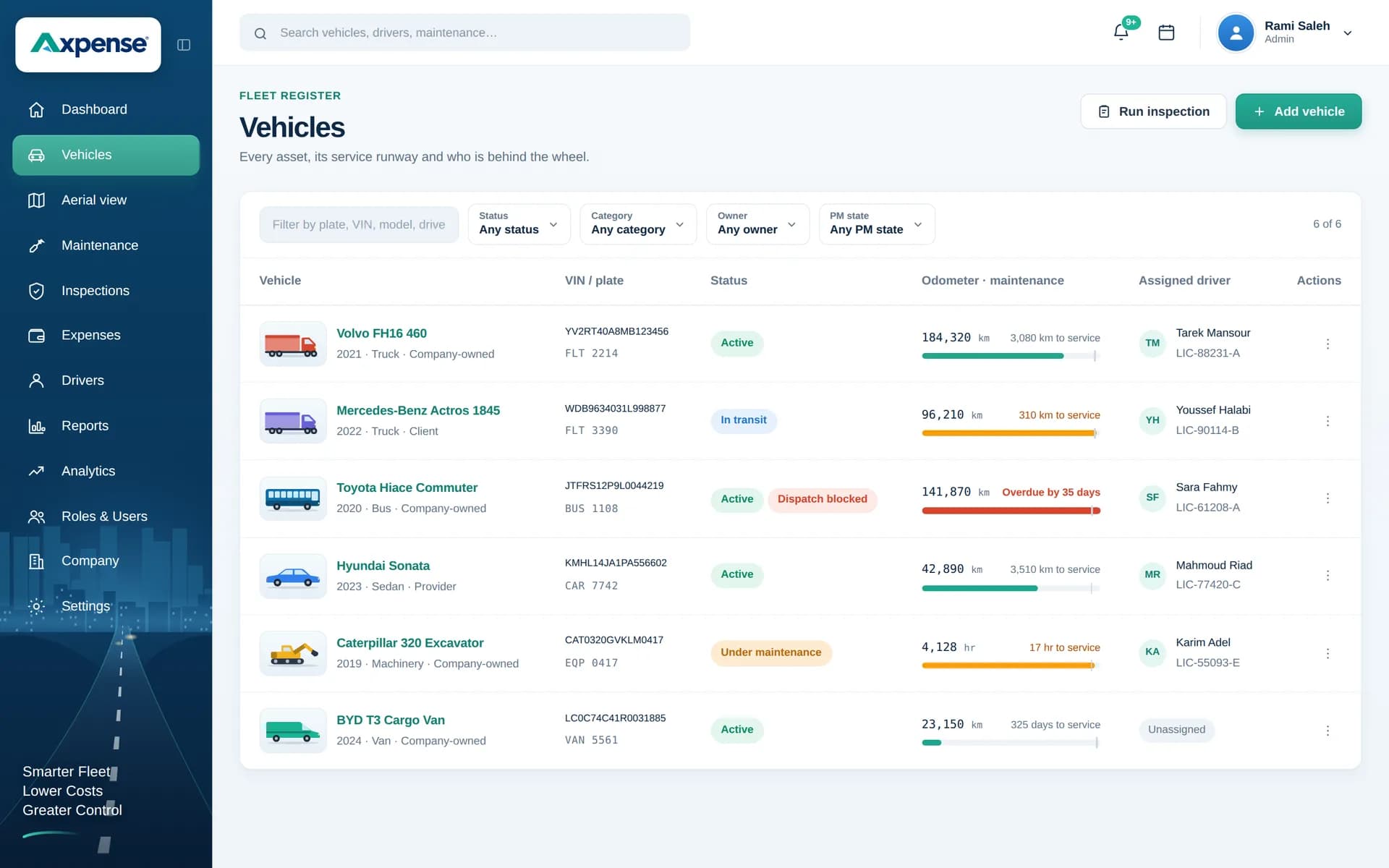
Contractors run vehicles on rough ground, far from the head office workshop and spread across projects that start and finish every few months. Axpense keeps each pickup, tipper, mixer truck and site vehicle on one record, with servicing by kilometre, site inspections and depreciation, so you know what every vehicle costs and what it is still worth.
Why construction fleets are hard to keep under control
A construction company’s fleet moves with its projects. Vehicles are sent to a new site, lent to another project manager, and come back months later with no clear record of what happened to them.
- Vehicles are scattered. Pickups and trucks sit on sites in different cities, and head office often doesn’t know which vehicle is where or who has it.
- Conditions are harsh. Dust, heat, unpaved roads and overloading shorten the life of tyres, filters, suspension and brakes.
- Costs land on projects, not vehicles. A repair is charged to the project that paid for it, so no one sees the total cost of one tipper across three projects.
- Asset values are guessed. When finance asks what the fleet is worth, or when a vehicle should be sold, the answer comes from memory rather than records.
Vehicles and equipment in a construction fleet
A contractor’s road-going fleet usually includes double-cab pickups for engineers and foremen, tipper trucks for earth and aggregates, concrete mixer trucks, flatbeds and low-loaders, water tankers and crew buses. All of these have odometers and plates, and Axpense manages them as vehicles: one record each with make, model, odometer, status and assigned driver.
Most contractors also own site machinery such as excavators, loaders and generators. Those usually follow a different service logic, based on running time rather than distance. If machinery is a large part of your fleet, raise it in your demo so we can show you what fits today.
Maintenance needs: shorter intervals for severe conditions
Most manufacturers publish a separate, shorter schedule for severe duty: dusty environments, short trips, heavy loads and unpaved roads. Construction vehicles usually qualify. That means air filters, oil and brake checks come round sooner than on the same model used in town.
In Axpense you set each vehicle’s service intervals in kilometres, and the system shows the kilometres left to each service and flags the overdue ones. Because every service is kept in the vehicle’s history, a truck that moves from one project to another keeps its records with it. Parts fitted on site, such as tyres and filters, can be recorded through spare parts so you see which vehicle they went into. For the maintenance side in depth, see fleet maintenance software.
Cost needs: running cost and depreciation per vehicle
Construction vehicles are capital assets. Axpense records repairs, parts, insurance and registration per vehicle and calculates book value over time, so you can weigh what a vehicle costs to run against what it is still worth.
Straight-line depreciation per year
(Purchase price − expected resale value) ÷ years of use
Cost per km
Total operating costs for the period ÷ km driven in the period
Example: a tipper truck
A tipper bought for 3,200,000 EGP, expected to resell for 800,000 EGP after 6 years, loses 400,000 EGP of book value a year. If its repairs and parts cost 450,000 EGP this year and are rising, it now costs more to keep running than it loses in value, which is a signal to plan its replacement. See vehicle depreciation and lifecycle for how Axpense shows book value.
Inspection needs: site checks when vehicles arrive and every week
A vehicle arriving on site should be checked before it starts work, and again at a regular interval. A typical construction checklist covers:
Tyres and wheels for cuts, damage and wear from rough ground.
Brakes, lights, reversing alarm and beacon.
Tipper body, hydraulics or mixer drum for leaks and damage.
Load restraints, tailgate locks and mirrors.
Seat belts, fire extinguisher and first-aid kit present.
A construction workflow in Axpense
- 1
Register every road-going vehicle
Pickups, tippers, mixers, tankers and buses, with plate, odometer and status.
- 2
Assign drivers and foremen
Link each vehicle to the person responsible for it on site.
- 3
Set severe-duty km intervals
Use the manufacturer’s severe-duty schedule; Axpense tracks km left and overdue services.
- 4
Inspect on arrival and weekly
Checklists record pass or fail per item; failed items stay on the vehicle record.
- 5
Record costs and review book value
Log repairs and parts per vehicle, then compare running cost with depreciation.
Modules contractors use
Vehicle management
Every pickup, tipper and mixer on one list with odometer and status.
Preventive maintenance
Km-based intervals, suited to severe-duty schedules.
Inspections
Site arrival and weekly checklists with results on the vehicle.
Depreciation and lifecycle
Book value per vehicle to plan replacements and disposals.
Expenses
Repairs, parts, insurance and registration per vehicle.
Reports
Cost by vehicle and category across all projects.
KPIs to watch on a construction fleet
Common practice for contractors, built from the records you keep.
Running cost per vehicle against its yearly depreciation.
Services overdue, especially on vehicles at remote sites.
Days off the road per vehicle, by project.
Tyre spend per vehicle, a direct measure of site conditions.
Example: a contractor with 35 vehicles on four sites
Consider a hypothetical contractor running 12 pickups, 10 tippers, 6 mixer trucks, 4 water tankers and 3 crew buses across four projects. Each project manager keeps their own notes; costs are charged to projects; the finance team estimates vehicle values once a year.
The fleet team registers all 35 vehicles in Axpense with purchase prices and odometer readings, sets severe-duty intervals and assigns a responsible foreman to each vehicle. Site checklists begin on arrival at each project. When a tipper moves from one project to another, its service history, inspections and costs move with it, because they belong to the vehicle rather than the project.
At the end of the year, finance has book values from records instead of estimates, and the fleet manager can point to the few tippers whose repair costs now exceed their yearly depreciation as the first candidates for replacement.
Frequently asked questions
Which construction vehicles can I manage in Axpense?
Any road-going vehicle with an odometer: pickups, tipper trucks, concrete mixer trucks, flatbeds, water tankers and crew buses. Each gets a vehicle record with km-based maintenance, inspections, expenses and depreciation.
How do I keep records when vehicles move between projects?
Services, inspections and expenses are stored on the vehicle, not the project, so the full history stays with the vehicle wherever it works.
Does Axpense calculate depreciation?
Yes. Axpense shows each vehicle’s book value over time, so you can compare running costs with the value it is losing. Read more in what is asset management.
What should a site vehicle inspection include?
Tyres and wheels, brakes and lights, reversing alarm, body or hydraulics, load restraints and safety equipment on board. In Axpense you build the checklist to match your sites. See our vehicle inspection software.
How quickly can we get started?
Most teams are live in one day with free onboarding. See plans on the pricing page.
Related guides
What Is Asset Management? Lifecycle, Depreciation and Replacement
What is asset management for vehicles and equipment: lifecycle stages, the asset register, a depreciation example in EGP and how to decide when to replace.
Read articleFleet Total Cost of Ownership: How to Calculate TCO and Compare Vehicles
How to calculate fleet total cost of ownership, compare two vehicles on TCO, and use the numbers to decide when a vehicle should be replaced.
Read articlePreventive vs Reactive Maintenance: Costs, Trade-offs and How to Switch
Preventive vs reactive maintenance for vehicle fleets: what each costs, when fixing on failure is acceptable, and how to move to planned servicing in stages.
Read articleSee Axpense with your own fleet
Book a short demo. We’ll set up a few of your vehicles and show you how it works day to day.