
Fuel expenses
Fuel Expense Tracking for Every Vehicle in Your Fleet
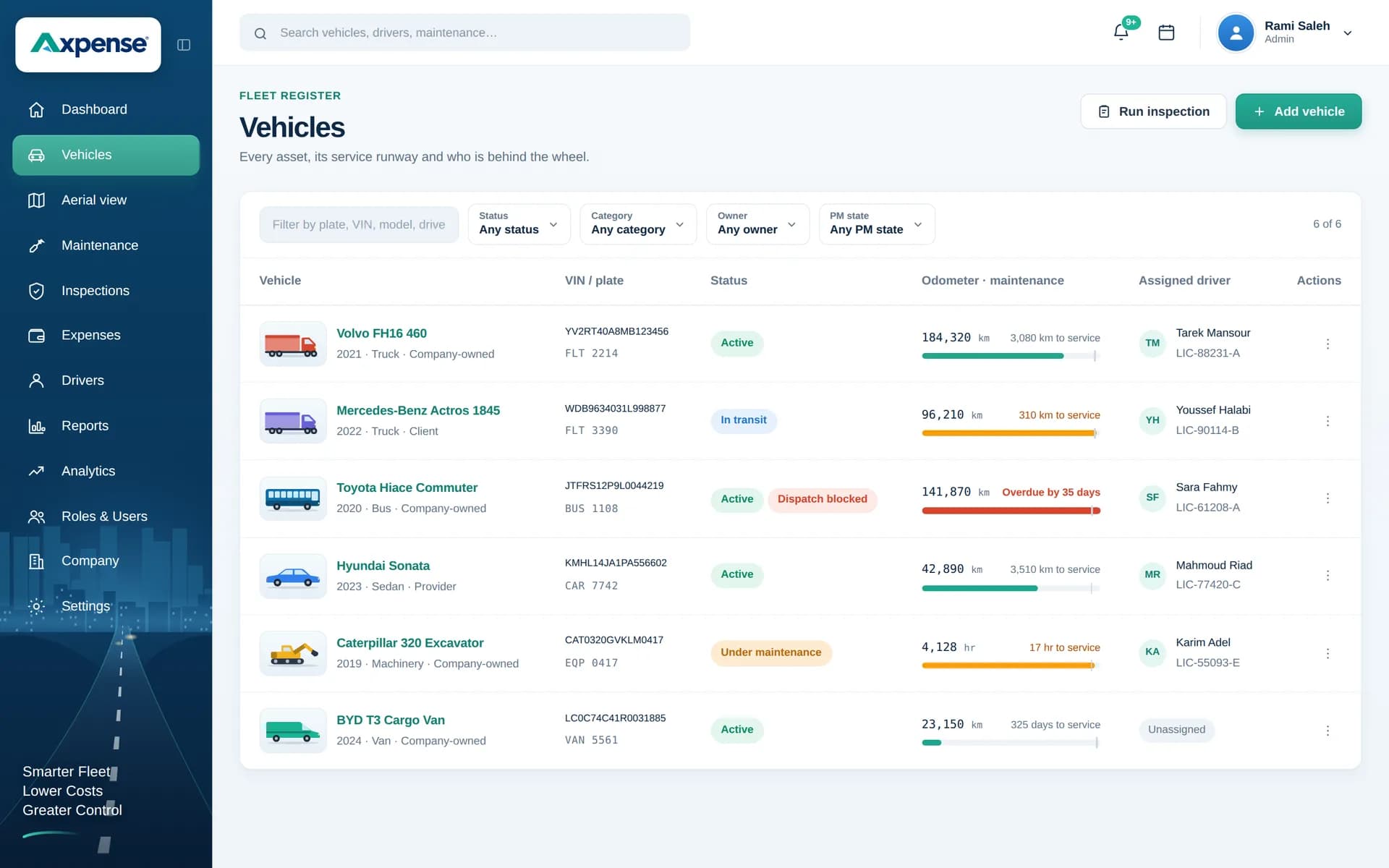
Fuel is usually the largest running cost a fleet has, and the hardest to see clearly. Record each fill-up against the vehicle it went into, with litres, amount and odometer reading, and Axpense shows what fuel costs per vehicle and per kilometre.
What is fuel expense tracking?
Fuel expense tracking means recording every fuel purchase against the vehicle that received it, so fuel cost can be measured per vehicle and per kilometre. A monthly fuel total tells you how much the company paid; per-vehicle records tell you which vehicles are using more than they should.
Many companies pay for fuel through cash advances, station accounts or reimbursed receipts. The money is accounted for, but it is rarely tied to a vehicle and an odometer reading. Without those two facts you cannot calculate consumption, and without consumption you cannot tell normal use from waste.
How fuel records work in Axpense
Each fuel entry is recorded on a vehicle with the date, litres, amount paid and the odometer reading at the fill-up. From those entries Axpense can show:
- Fuel spend per vehicle for any month, next to that vehicle’s maintenance and other costs.
- Fuel cost per km, from the amount spent and the kilometres driven between readings.
- Consumption, in litres per 100 km, so similar vehicles can be compared fairly.
Fuel entries sit on the same vehicle record as services and expenses, so a vehicle’s full running cost is in one place. Entries are recorded by your team; Axpense does not connect to fuel cards or vehicle sensors.
Two formulas every fleet should use
Fuel cost per km
Fuel spend for the period ÷ km driven in the period
Consumption (L/100 km)
(Litres used ÷ km driven) × 100
Example: two identical pickups on similar routes
Two pickups of the same model work similar routes in one month. The figures are illustrative.
| Pickup 1 | Pickup 2 | |
|---|---|---|
| Km driven | 4,000 | 3,800 |
| Litres | 440 | 570 |
| Fuel spend (EGP) | 6,600 | 8,550 |
| L/100 km | 11.0 | 15.0 |
| Fuel cost per km (EGP) | 1.65 | 2.25 |
Pickup 2 drove fewer kilometres but used about a third more fuel per kilometre. That is worth a question: a mechanical issue such as tyre pressure or a clogged filter, a different driving style, or fuel that isn’t going into the vehicle at all.
Spotting abnormal consumption: a practical routine
Good records make problems visible. This monthly routine turns them into action.
- 1
Record every fill-up with the odometer
Make the odometer reading part of the routine. Without it, consumption cannot be calculated.
- 2
Compare like with like
Compare L/100 km across vehicles of the same model and similar routes, not a city van with a highway truck.
- 3
Set your own normal range
After two or three months, you will know the usual range for each vehicle type. Anything well outside it needs a look.
- 4
Check the vehicle first
Before suspecting anyone, rule out mechanical causes: tyres, filters, injectors and overdue services all raise consumption.
- 5
Talk to the driver
If the vehicle is fine, review the pattern with the assigned driver. Most gaps have an ordinary explanation; some don’t.
Odometer readings are the base of every fuel figure
Accurate odometer readings on each vehicle make fuel cost per km and consumption figures reliable.
Who uses fuel records
- Fleet managers compare consumption across vehicles and follow up on the outliers.
- Finance teams see fuel spend by vehicle instead of one large monthly figure.
- Supervisors use fuel records together with driver assignments to discuss driving habits with the right person.
Fuel is one line in the full cost of a vehicle. To combine it with repairs, parts, insurance and depreciation, see fleet cost tracking, or work out a vehicle’s full cost per kilometre with our fleet cost per km calculator.
Frequently asked questions
What do I record for each fill-up?
The vehicle, date, litres, amount paid and the odometer reading. The odometer reading is what makes fuel cost per km and consumption possible.
How is fuel cost per km calculated?
Fuel spend for a period divided by the kilometres driven in that period. For example, 6,600 EGP of fuel over 4,000 km is 1.65 EGP per km.
How do I spot abnormal fuel consumption?
Compare litres per 100 km between vehicles of the same model on similar routes. A vehicle well above the others should be checked mechanically first, then reviewed with its driver.
Does Axpense connect to fuel cards or GPS devices?
No. Fuel entries are recorded by your team. That keeps setup simple and works with any payment method, including cash and station accounts.
Can I see fuel together with other vehicle costs?
Yes. Fuel entries are stored on the same vehicle record as maintenance and expenses, so the vehicle’s full running cost is in one place.
Related guides
How to Calculate Vehicle Cost per km: Formula and Worked Examples
The formula for vehicle cost per km, which costs to include, worked examples in EGP and SAR, and the mistakes that make the number misleading.
Read articleHow to Calculate Fleet Costs and Build a Fleet Budget
How to calculate fleet costs for the whole fleet: fixed vs variable costs, cost categories, a 20-vehicle monthly budget in EGP and a variance review routine.
Read articleFleet Total Cost of Ownership: How to Calculate TCO and Compare Vehicles
How to calculate fleet total cost of ownership, compare two vehicles on TCO, and use the numbers to decide when a vehicle should be replaced.
Read articleSee Axpense with your own fleet
Book a short demo. We’ll set up a few of your vehicles and show you how it works day to day.