
Depreciation and lifecycle
Vehicle Depreciation and Asset Lifecycle Management
Every vehicle loses value from the day it is bought. Axpense shows each vehicle’s book value over time, next to what it costs to maintain, so you can see where it is in its lifecycle and plan replacements before an ageing fleet starts costing more than it earns.
What is vehicle depreciation and lifecycle management?
Vehicle depreciation and lifecycle management means tracking how much each vehicle is worth as it ages, and using that together with its running costs to decide when to replace it. Depreciation is the fall in a vehicle’s value over its years of use; the lifecycle is the path from purchase to sale.
Most companies know the purchase price of their vehicles and little else. Without the current book value, replacement decisions are made on gut feel, often only after a major breakdown. With it, the fleet manager and the finance team can talk about the same numbers.
How depreciation works in Axpense
Each vehicle in Axpense carries its purchase details, and Axpense shows its book value over time: what the vehicle is worth on paper today, and how that value will fall over the rest of its planned life.
Because depreciation sits on the same vehicle record as maintenance history and expenses, you can read the two sides together. A vehicle with a low book value and rising repair costs is a very different case from one with plenty of value left and low running costs.
Axpense is an operational tool. Your accountant decides the depreciation method used in your official books; the figures in Axpense are for planning fleet decisions.
Straight-line depreciation, with a worked example
Straight-line is the simplest and most widely used method: the vehicle loses the same amount of value each year of its planned life.
Annual depreciation
(Purchase price − Expected resale value) ÷ Years of use
Book value at end of year N
Purchase price − (Annual depreciation × N)
Example: a delivery van over five years
A company buys a van for 900,000 EGP, plans to use it for 5 years and expects to sell it for 300,000 EGP. Annual depreciation = (900,000 − 300,000) ÷ 5 = 120,000 EGP per year.
| Year | Depreciation (EGP) | Book value at year end (EGP) |
|---|---|---|
| 0 (purchase) | — | 900,000 |
| 1 | 120,000 | 780,000 |
| 2 | 120,000 | 660,000 |
| 3 | 120,000 | 540,000 |
| 4 | 120,000 | 420,000 |
| 5 | 120,000 | 300,000 |
If this van’s repair and parts costs climb to 90,000 EGP a year by year four, you are spending most of its annual depreciation again just to keep it running. That is the signal to start planning its replacement.
The four stages of a vehicle’s lifecycle
Every vehicle moves through the same stages. Axpense keeps the record for each one on a single vehicle file.
- 1Acquisition: purchase price and date recorded
- 2Service life: maintenance, inspections and expenses build up
- 3Replacement: book value and costs reviewed
- 4Disposal: vehicle sold or retired
Before you dispose of a vehicle, review its full cost and service history: it is the best guide to whether the same model is worth buying again.
Planning replacements with numbers, not guesses
There is no single right age to replace a vehicle; a van driving 60,000 km a year wears out long before a manager’s car. A practical review looks at three things for each vehicle:
- Book value: how much value is left to lose.
- Running cost trend: whether repairs and parts are rising year on year, from the cost records Axpense already keeps.
- Reliability: how often the vehicle is off the road for unplanned repairs, visible in its service history.
When value is low, costs are rising and breakdowns are frequent, replacement usually costs less than keeping the vehicle. Our fleet total cost of ownership guide explains how to put purchase, running costs and resale into one figure.
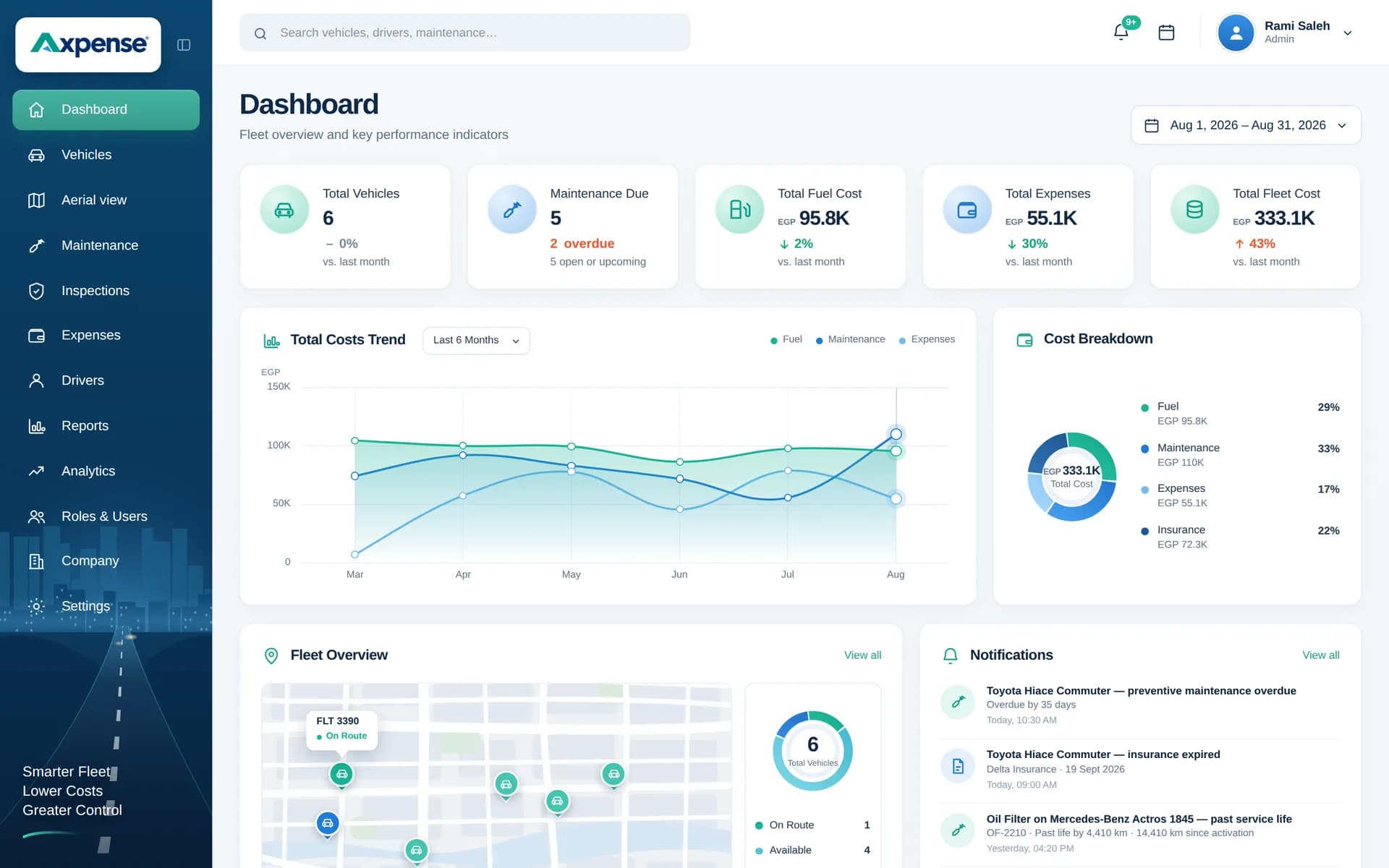
Fleet value and costs on one dashboard
Read book value and running costs together to decide which vehicles to replace first.
Who uses depreciation and lifecycle data
- Fleet managers build the replacement list for next year with evidence behind each vehicle on it.
- Finance teams see the current book value of the fleet and can plan purchase budgets for the coming years in advance.
- General managers get a clear view of the fleet’s age and value when approving capital spending.
Depreciation is one part of the full cost picture. For how it combines with running costs, cost per kilometre and ownership cost, see fleet cost tracking.
Frequently asked questions
How is vehicle depreciation calculated?
The most common method is straight-line: (purchase price − expected resale value) ÷ years of use gives the value lost each year. A 900,000 EGP van expected to sell for 300,000 EGP after 5 years depreciates by 120,000 EGP a year.
What does Axpense show for each vehicle?
Its book value over time, on the same record as its maintenance history and expenses, so you can see both what the vehicle is worth and what it costs to keep.
Can Axpense replace our accounting depreciation schedule?
No. Axpense is built for fleet decisions. Your accountant sets the method for the official books; Axpense gives the fleet team a clear view of value over time for planning.
When should a company vehicle be replaced?
When its remaining value is low, its running costs are rising and it breaks down more often. Reviewing book value, cost trend and service history together gives a defensible answer for each vehicle.
What are the stages of a vehicle’s lifecycle?
Acquisition, service life, replacement and disposal. Axpense keeps the purchase details, maintenance, expenses and book value for each stage on one vehicle record.
Related guides
Fleet Total Cost of Ownership: How to Calculate TCO and Compare Vehicles
How to calculate fleet total cost of ownership, compare two vehicles on TCO, and use the numbers to decide when a vehicle should be replaced.
Read articleWhat Is Asset Management? Lifecycle, Depreciation and Replacement
What is asset management for vehicles and equipment: lifecycle stages, the asset register, a depreciation example in EGP and how to decide when to replace.
Read articleHow to Calculate Vehicle Cost per km: Formula and Worked Examples
The formula for vehicle cost per km, which costs to include, worked examples in EGP and SAR, and the mistakes that make the number misleading.
Read articleSee Axpense with your own fleet
Book a short demo. We’ll set up a few of your vehicles and show you how it works day to day.